
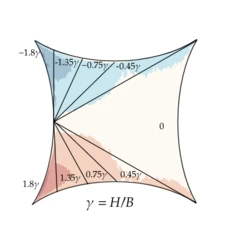
The ERIES-WENSS project focuses on the experimental and numerical investigation of wind effects on non-standard, doubly curved lightweight structures, in particular, prestressed membrane canopies.
Such structures are widely used in contemporary architecture, yet current wind design provisions rely heavily on simplified assumptions due to the lack of standardized aerodynamic data for complex geometries.
The project aims to close this gap by providing high-resolution, standardized aerodynamic datasets obtained from wind tunnel experiments and complementary numerical simulations, enabling improved codification and safer, more economical structural design.
Experimental Campaign
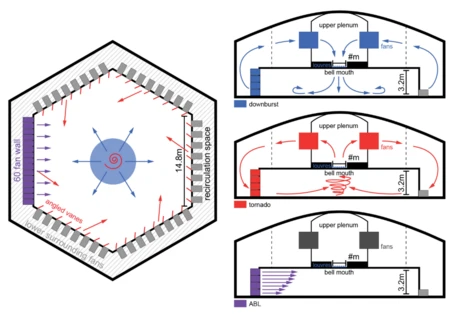
A comprehensive experimental campaign was carried out at the WindEEE Dome facility (Western University, Canada), which allows the reproduction of a wide range of atmospheric and non-synoptic wind phenomena.
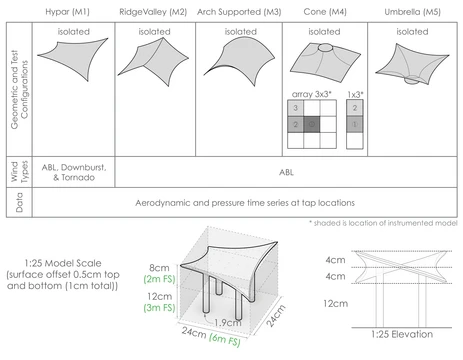
Five representative doubly curved membrane geometries were investigated at a scale of 1:25:
- Hyperbolic paraboloid (hypar)
- Ridge-valley canopy
- Arch-supported canopy
- Cone-shaped canopy (isolated and grouped configurations)
- Umbrella-type canopy
All models were instrumented with dense pressure tap layouts on both upper and lower membrane surfaces, allowing the derivation of net pressure distributions.
Tests were conducted under atmospheric boundary layer (ABL) flow, with additional tornado-like and downburst-like wind fields for the hypar model.
The resulting dataset comprises more than 400 individual wind tunnel tests, providing time-resolved pressure data suitable for detailed aerodynamic analyses and validation studies.
Numerical Simulations and Parametric Studies
In addition to the experimental program, the ERIES-WENSS project includes numerical investigations using CFD and coupled CFD–FSI approaches.
A systematic set of parametric simulations is carried out on multiple geometric variants of the tested canopy types, enabling:
- Assessment of geometric sensitivity of wind pressure coefficients
- Comparison between wind tunnel measurements and CFD / FSI results
- Identification of robust, geometry-dependent aerodynamic trends
The combined experimental–numerical approach allows the derivation of standardized pressure coefficients and characteristic load values, bridging the gap between isolated project-specific studies and generalized design recommendations.
Data Availability
All experimental data generated within the project are published as open-access datasets, including detailed documentation, geometry definitions, pressure time series, and post-processing scripts.
The data are intended for use in aerodynamic analyses, numerical validation studies, and the development of future wind engineering guidelines.