
Model Calibration
Load/Boundary/Constitutive Law/… Identification
Adjoint-Based System Identification for Model Validation and Qualification
Many structural health monitoring (SHM) techniques use finite-element models to track the health of a structure throughout its lifetime. To have an accurate system identification of the current state, it is vital that the model is accurate in terms of geometry, loading, and boundary conditions, such that it qualifies to conduct SHM and track other relevant damage indicators. Therefore, a finite element (FE) dependent, high--fidelity, adjoint--based, optimization--driven procedure focusing primarily on factors other than the material parameters, i.e., related to boundary and loading conditions is proposed. An optimization problem with the objective of minimizing the weighted differences between the model response and the sensor measurements is formulated. The gradients are efficiently calculated using the adjoint method, and Vertex Morphing (VM) is used to regularize the optimization by filtering the sensitivities. The results demonstrated a sufficiently good identification of the system parameters and capturing underling trends.
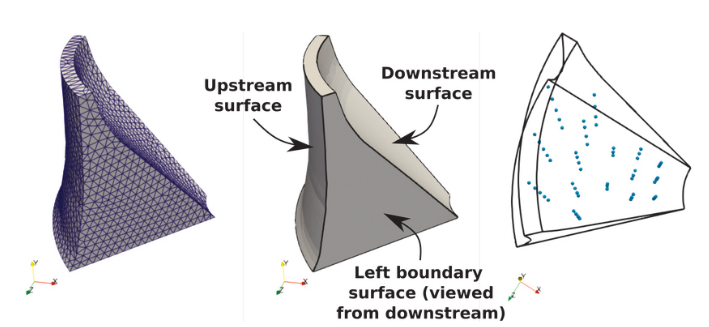
Dam example: Mesh used (left), dam geom- etry (center), and the sensor distribution viewed from above (right).
© Courtesy of the Chair of Structural Analysis, Technical University of Munich
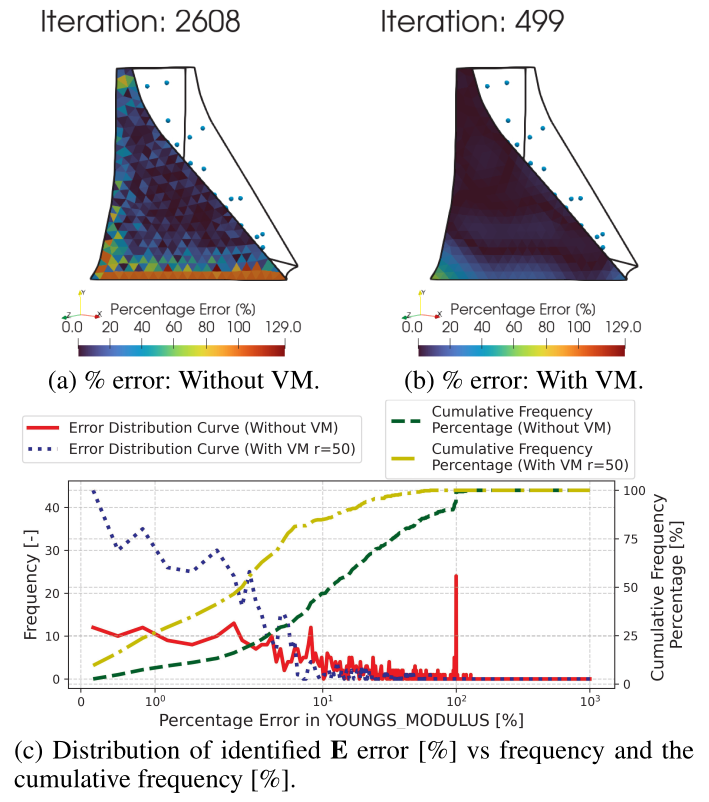
Dam example, Boundary stiffness identification of a 1 mm thin layer along the dam’ left edge (cf. Fig. 4): Identified Young’s modulus percentage error (top) and its distribution (bottom) at the con- verged iterations without and with VM r = 50.
© Courtesy of the Chair of Structural Analysis, Technical University of Munich
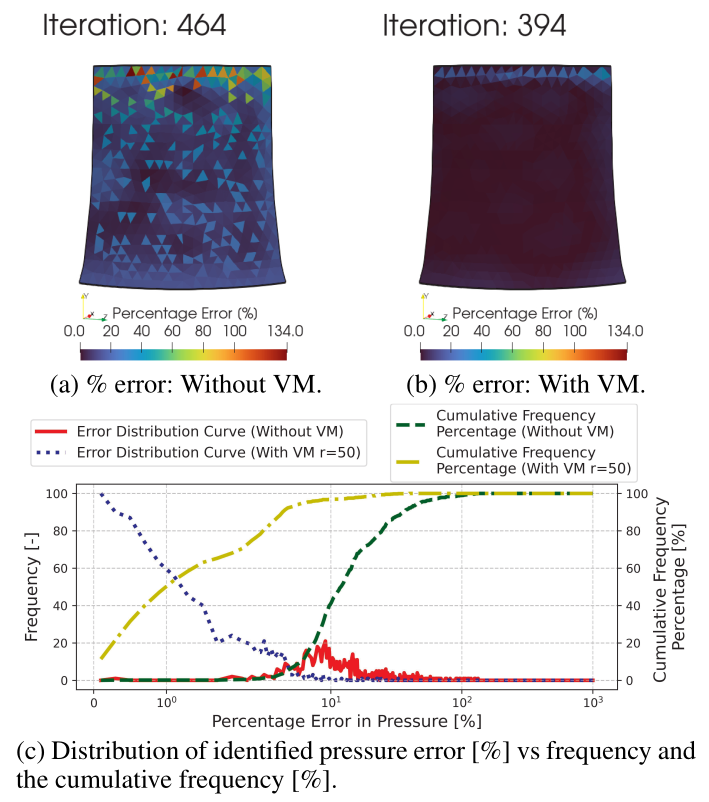
Dam example, Load identification on the upstream surface: Identified pressure percentage error (top) and its distribution (bottom) at the converged iterations without and with VM r = 50.
© Courtesy of the Chair of Structural Analysis, Technical University of Munich
Adjoint-Based Material Parameters and Constitutive Model Identification From Deformation Measurements.
Accurate description of the constitutive relation and the material parameters are necessary for constructing accurate digital twins of structures. However, the real-world structure’s material parameters and constitutive relation might differ from the ideal properties used in the model. Common SHM approaches focus on identifying the material parameters such as Young’s modulus of the structure to detect an anomaly. While this information represents the current state of the structure accurately, prediction regarding the remaining life of the structure is challenging as the underlying constitutive behaviour has likely changed, thereby highlighting the necessity of material model-accurate predictive digital twins. In this work, we address the material model identification by first decoupling it into two manageable sub-problems, material parameters identification and constitutive model identification, to gain a deeper understanding of each component’s characteristics. The parameter identification includes identifying the material constants, given a constitutive law. While the constitutive problem discovers the constitutive model influencing the material behaviour given a set of material parameters. Both the sub-problems are formulated as adjoint-based sensitivities driven optimization tasks with the objective to minimize the weighted differences between the model and the deformation measurements obtained from displacement or strain sensors.
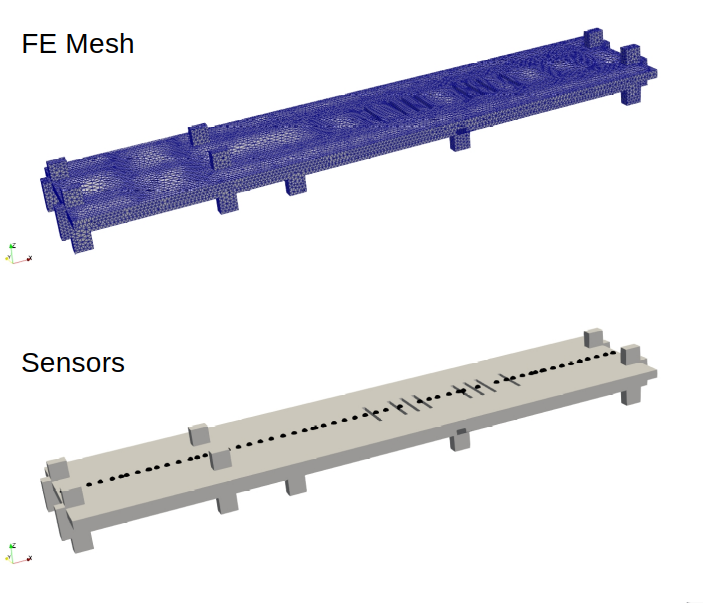
Concerto Bridge. Mesh and Sensor Locations
© Chair of Structural Analysis, Technical University of Munich
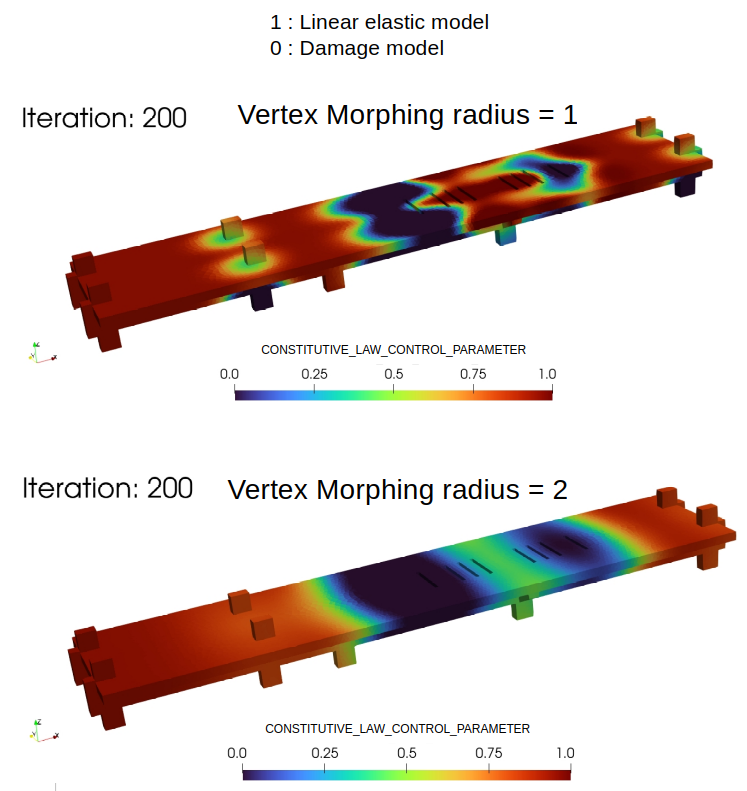
Concerto Bridge. System Identification. Material behavior change due to damage..
© Chair of Structural Analysis, Technical University of Munich
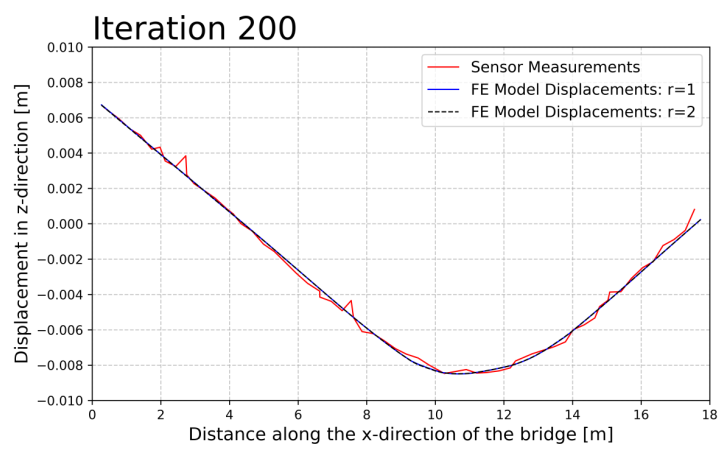
Concerto Bridge. System Identification. Actual vs Predicted Displacements
© Chair of Structural Analysis, Technical University of Munich
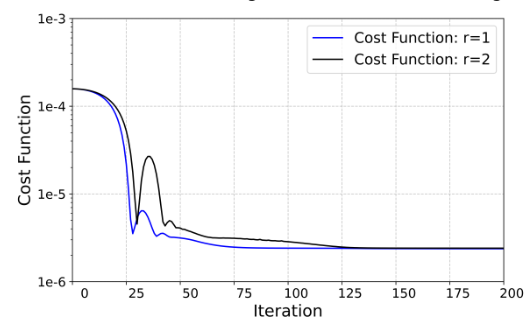
Concerto Bridge. System Identification Convergence Plot.
© Chair of Structural Analysis, Technical University of Munich