
High-Fidelity Damage Detection
Motivation
During their lifecycle, structures age and change their properties due to different reasons, for instance damage, corrosion or fatigue. With increasing maturity of sensor technology and numerical simulation techniques, it is possible to build digital representations (Digital-Twining) of complex structures. One of the most important steps of Digital Twinning is system identification, which involves identification of the current state of the material properties and/or localization of the weakening. This requires solving the inverse problem using suitable parameterization of the structure which is typically formulated as an optimization problem.
Adjoint-Based Determination of Weaknesses in Structures
An adjoint-based procedure to determine weaknesses, or, more generally the material properties of structures is developed and tested. Given a series of force and displacement/strain measurements, the material properties are obtained by minimizing the
adequately weighted differences between the measured and computed values. The approach is directly based on the finite element model of the structure of interest, which can be arbitrarily complex and be composed of any kind of element formulation. This is especially advantageous in complicated real-world applications. As a consequence, the procedure can provide highly resolved parameter distributions within the structure and allows for the localization of e.g. damage regions or other zones with deviations from the planned configuration. Several examples with truss, plain strain and volume elements show the viability, accuracy and efficiency of the proposed methodology using both displacement and strain measurements. An important finding was that in order to obtain reliable, convergent results the gradient of the cost function has to be smoothed appropriately.
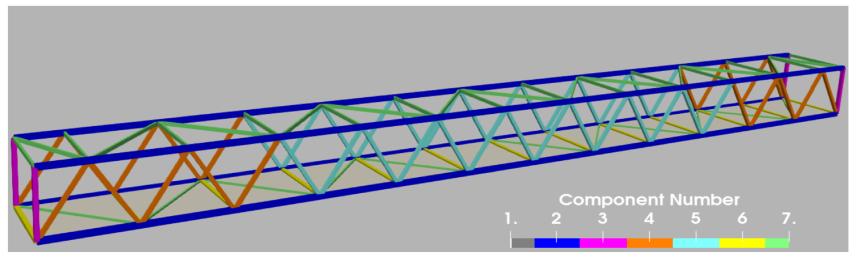
Footbridge: Components
© Courtesy of the Chair of Structural Analysis, Technical University of Munich
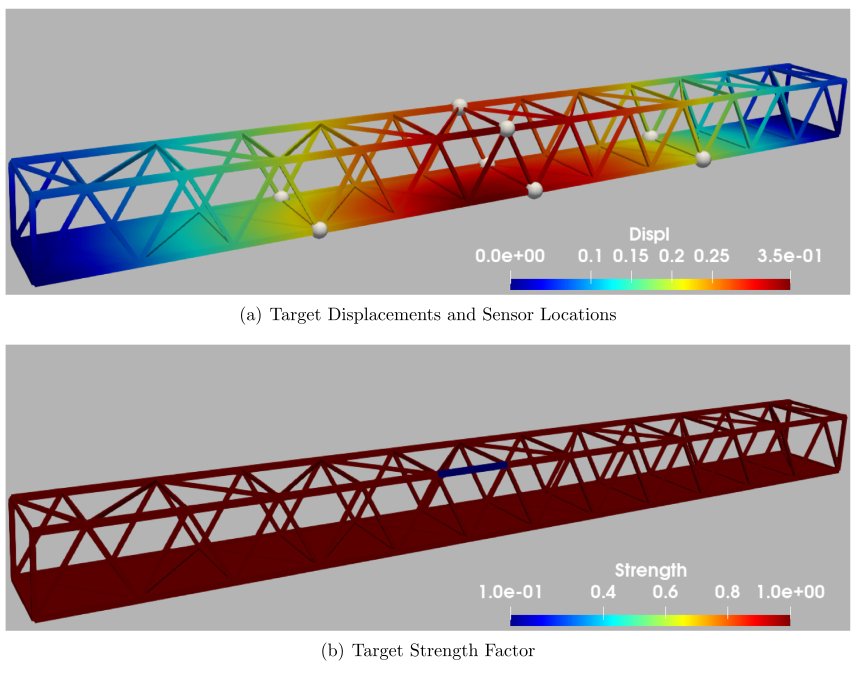
Footbridge: Target Conditions. The color bars at the bottom right correspond to the actual displacements and strength factors, respectively.
© Courtesy of the Chair of Structural Analysis, Technical University of Munich
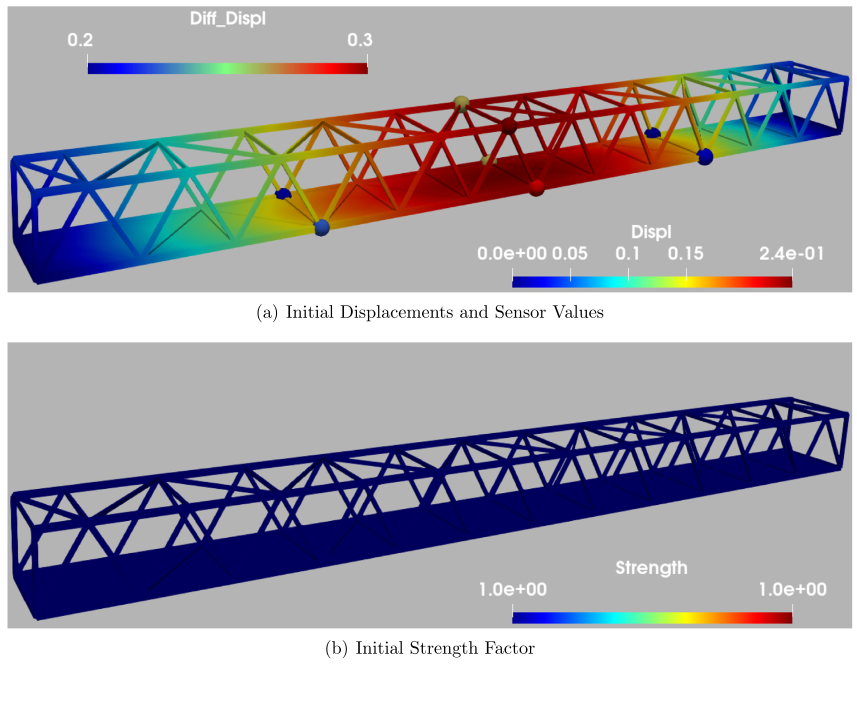
Footbridge: Initial optimization iteration. Figure (a) shows the displacements and (b) corresponds to the strength factor. The color bar on top left displays the magnitude of the difference between target and actual displacements at the measuring points.
© Courtesy of the Chair of Structural Analysis, Technical University of Munich
High-Fidelity Digital Twins: Zooming in on Weaknesses in Structures.
An adjoint-based procedure to determine weaknesses, or, more generally, the material properties of structures is improved by implementing two techniques to progressively reduce the regions considered as weakened. In this way, the number of degrees of freedom that are being optimized is reduced, leading to faster convergence and a better definition or `sharpening' of the weakened region. Several examples show the viability, accuracy and efficiency of the proposed methodology and its potential use for high fidelity digital twins.
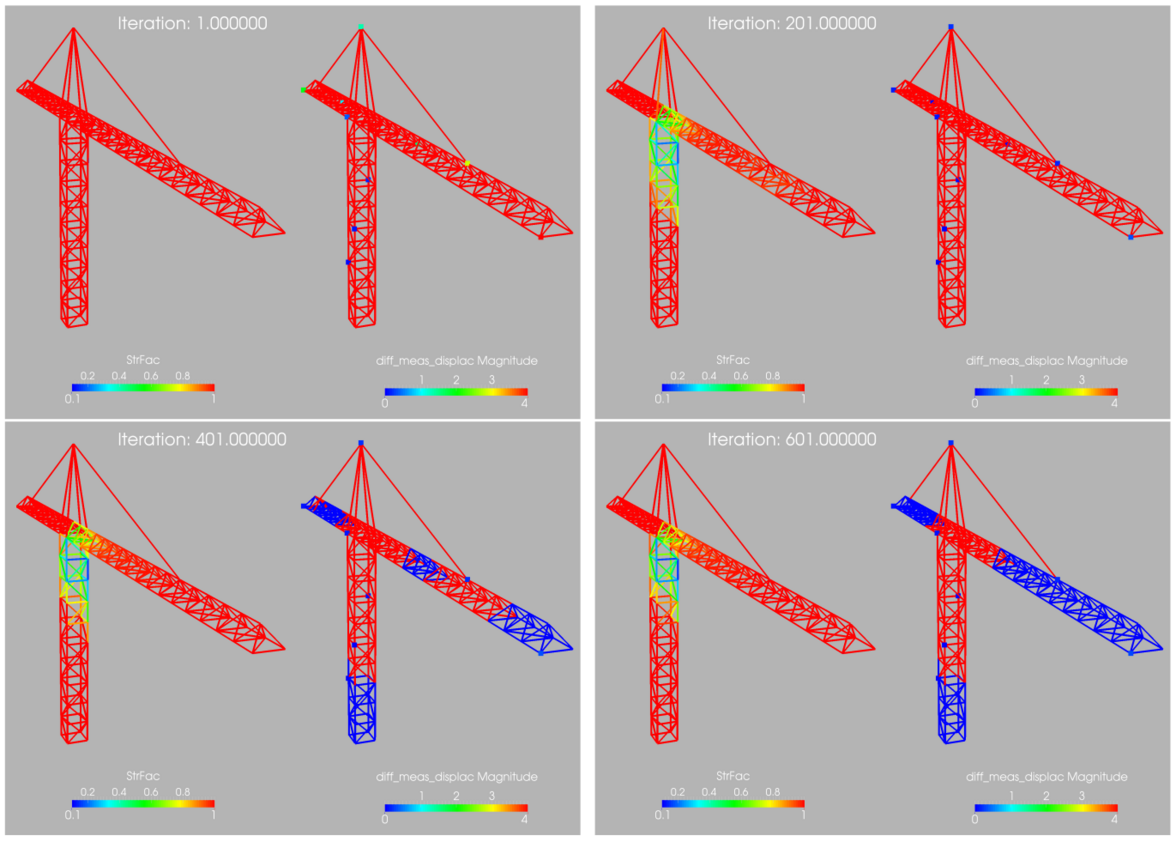
Crane: Evolution of Strength Factor (Left) and Deactivation Zones (Right)
© Courtesy of the Chair of Structural Analysis, Technical University of Munich
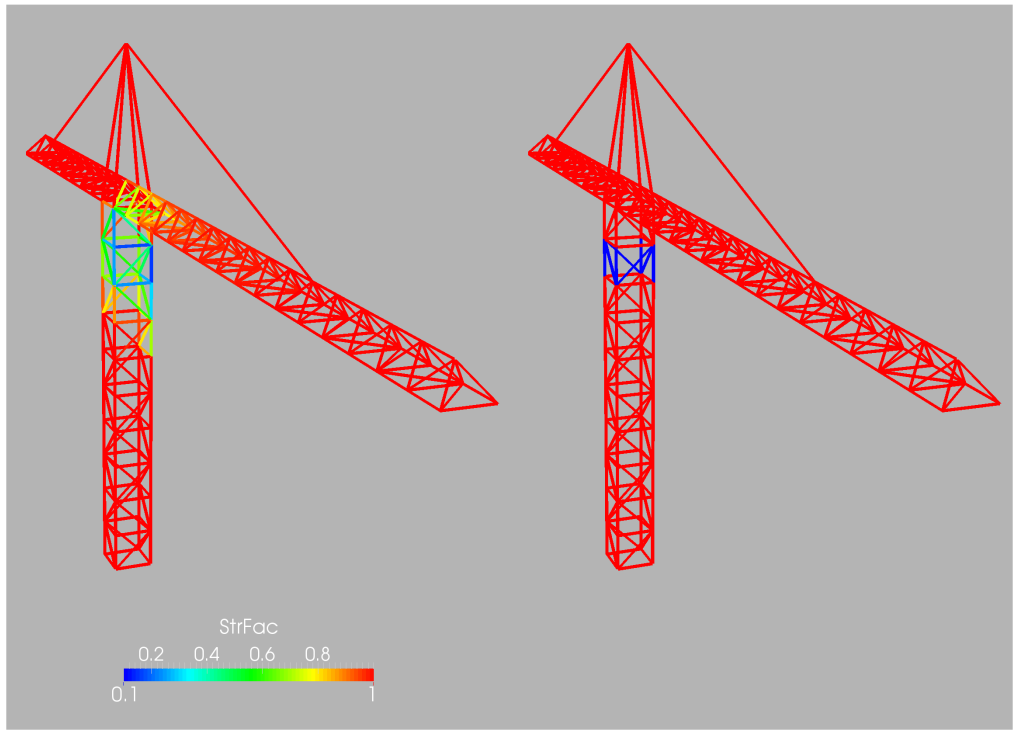
Crane: Final Strength Factor (Left) and Target Strength Factor (Right)
© Courtesy of the Chair of Structural Analysis, Technical University of Munich