
System Identification for Structural Membranes
Adjoint-Based Constitutive Parameters Identification in Membrane Structures Using Deformation Measurements
Membrane structures, valued for their flexibility and lightweight nature, are increasingly used in engineering applications. However, their mechanical behavior is challenging to predict due to uncertainties in material properties arising from fabrication methods, environmental exposure, and aging. To address this, we employ an adjoint-based system identification framework that estimates key constitutive parameters and prestress components directly from measurement data. The approach formulates a gradient-based optimization problem, leveraging adjoint sensitivities to efficiently recover material behavior from limited displacement or strain sensor input.
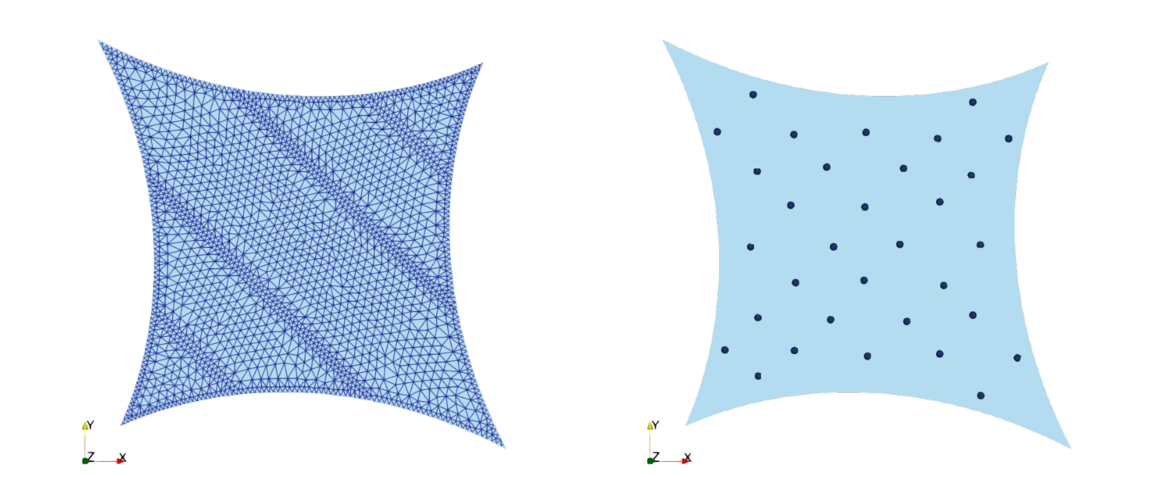
Hypar Example
Model Mesh (left) and the 32 Displacement Sensors Locations (right).
© Courtesy of the Chair of Structural Analysis, Technical University of Munich
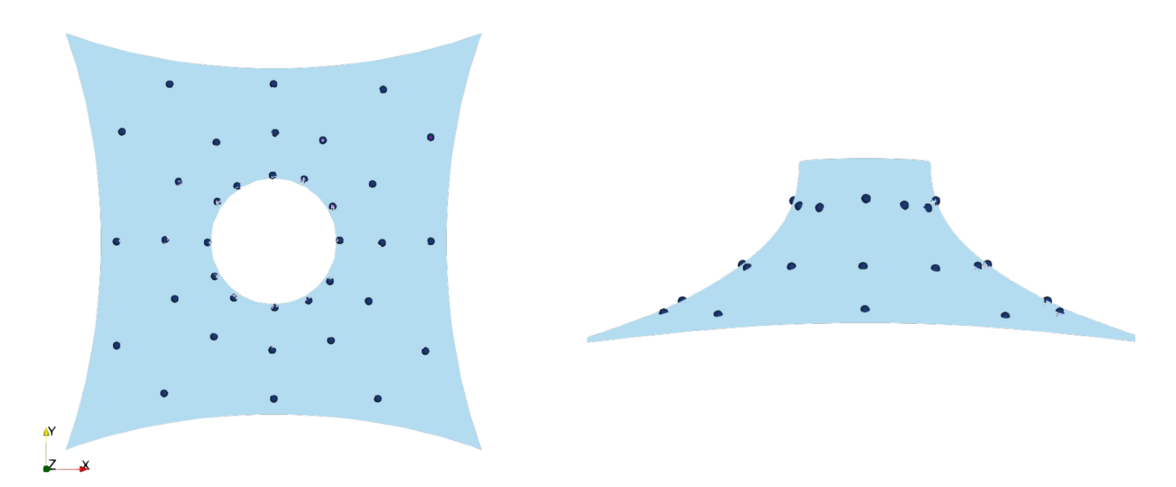
Conic Example
Top (left) and Side (right) View of the 36 Displacement Sensor Locations.
© Courtesy of the Chair of Structural Analysis, Technical University of Munich
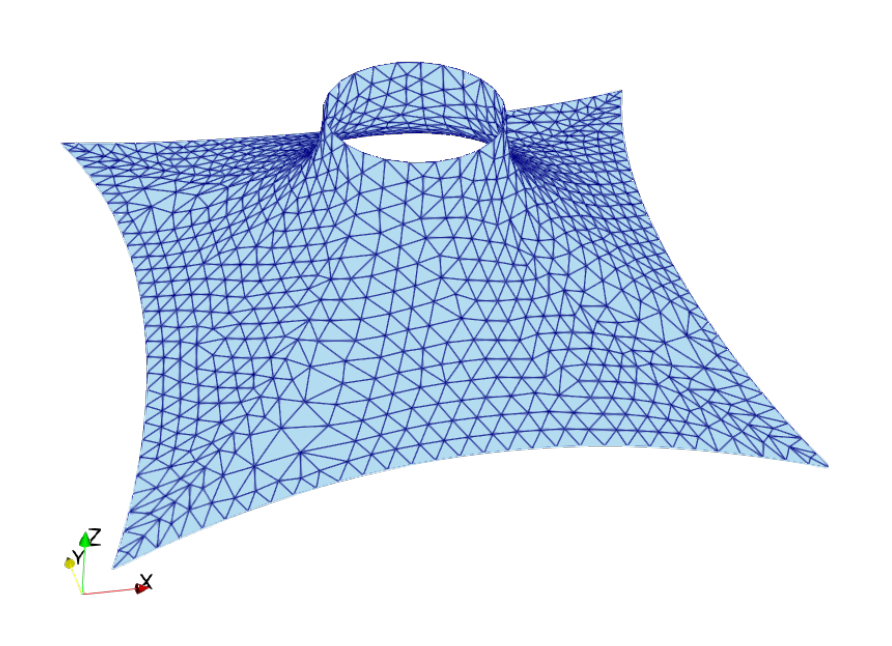
Conic Example
Model Mesh.
© Courtesy of the Chair of Structural Analysis, Technical University of Munich

Hypar Example
Case 2: Asymmetric Prestress and Orthotropic Young’s Modulus. Identified membrane material parameters and prestresses under different load conditions.
© Courtesy of the Chair of Structural Analysis, Technical University of Munich
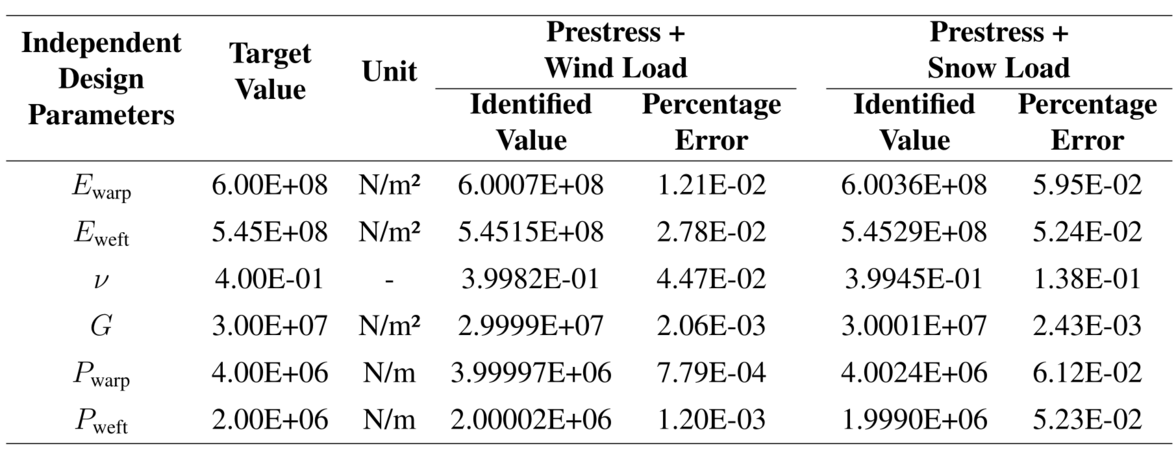
Conic Example
Case 2: Asymmetric Prestress and Orthotropic Young’s Modulus. Identified membrane material parameters and prestresses under different load conditions.
© Courtesy of the Chair of Structural Analysis, Technical University of Munich
System Identification in Membrane Structures: Seam Stiffness Calibration
In large membrane structures, panelization into patches creates stitched or welded seams. Overlaps and heat‑affected zones at these seams changes in‑plane stiffness locally, driving stress concentrations that standard uniform‑property models fail to capture. We aim to identify these localized stiffness changes by calibrating the seam and panel stiffness from measurements using a gradient‑based, system‑identification framework that minimizes simulation–measurement misfit. Seams are modeled by an increase in effective Young’s modulus; tighter bounds are used for the base fabric than seams, and a gradient cut-off at sensor error less than a threshold suppresses spurious gradients. We examine four fidelity levels—from low fidelity with two design variables to more than 100,000 variables in the high-fidelity cases—progressing from global seam/panel moduli to spatial fields for panels and seams. Applications to a four‑point hypar and a conic membrane under snow loading illustrate the workflow. In general, good identification is achieved in all cases; however, increasing fidelity exacerbates ill‑conditioning and reduces identification accuracy.

Courtesy of the Chair of Structural Analysis, Technical University of Munich

Courtesy of the Chair of Structural Analysis, Technical University of Munich

Courtesy of the Chair of Structural Analysis, Technical University of Munich

Courtesy of the Chair of Structural Analysis, Technical University of Munich

Courtesy of the Chair of Structural Analysis, Technical University of Munich

Courtesy of the Chair of Structural Analysis, Technical University of Munich

Courtesy of the Chair of Structural Analysis, Technical University of Munich

Courtesy of the Chair of Structural Analysis, Technical University of Munich

Courtesy of the Chair of Structural Analysis, Technical University of Munich

Courtesy of the Chair of Structural Analysis, Technical University of Munich

Courtesy of the Chair of Structural Analysis, Technical University of Munich

Courtesy of the Chair of Structural Analysis, Technical University of Munich