
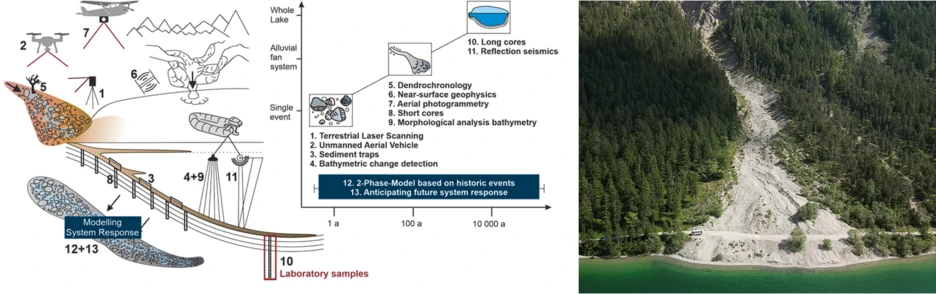
ALPHA: Deciphering Alpine hazard frequencies by amphibious investigations of Holocene lake inventories
1.-3.10. & 28-30.10.2025 Tree-ring sampling


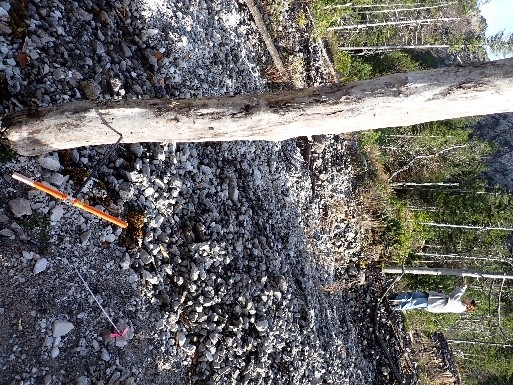
Trees on alluvial fans along the southern shore started. During the campaign increment cores from more than a hundred trees were collected in order to reconstruct debris flow events. The tree ring records will be analysed at FAU Erlangen-Nuremberg (https://www.geographie.nat.fau.de/).
29.09-02.10.2025 Sediment Coring Campaign at Plansee


The first lake-based fieldwork of the ALPHA project was successfully conducted at Plansee and Lake Heiterwang. During the campaign, we collected several sediment short cores along with grab samples. The cores will now be analyzed at the University of Innsbruck.
5.8.2025 ALPHA Fieldwork has started


We started the terrestrial fieldwork for the DFG ALPHA Project (Deciphering Alpine Hazard frequencies by amphibious investigations of Holocene lake inventories) with Electrical Resistivity Tomography over the three debris flow fans at Achensee.
22.7.2025 ALPHA kick-off at Achensee
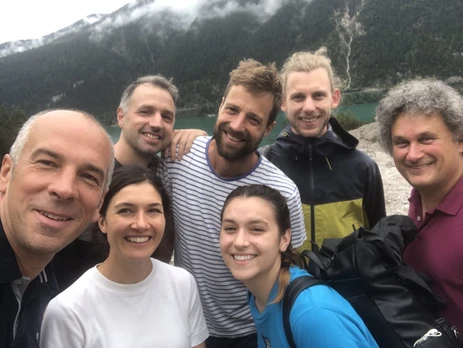
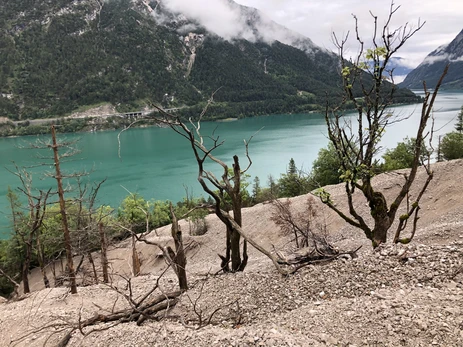
Our DFG Weave Lead Agency Project kick-off meeting together with our partners from University of Innsbruck, Friedrich-Albert University Erlangen and University of Bern was held on Achensee. By amphibious investigation of landslide deposits in and around Alpine Lakes, we want to answer how alpine hazard magnitudes and frequencies respond nonlinearly to environmental forcing. Lake sediments provide long-term records (in our case 10 000 years) as a sound basis for anticipating Alpine hazard frequencies in the forseeable future under various scenarios of climate change.