

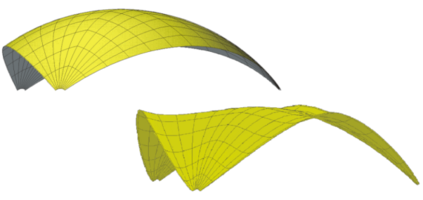
Initial geometry "Archara"

Optimized geometry "Archara"

Candela shell in Valencia: Shape optimization with implicit filters
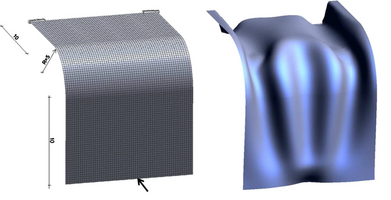
Shape optimization with explicit filters of a shell with a point load
Shape optimization of a shell structure with CAD parameterization

Mass minimization of a structural joint via shape optimization

Bead pattern optimizations of a flat plate
Motivation
In mathematical terms, optimization deals with improving (minimizing) an objective function by selectively modifying the design variables. For differentiable objective functions, gradient-based methods can be applied, which utilize the gradients to determine a suitable update of the design variables. Optimization problems are applied in numerous disciplines. By appropriately choosing the objective function and the design variables, almost any problem can be formulated as an optimization problem.
In the context of structures, we focus on structural optimization. Depending on the problem formulation, structural optimization can be divided into three categories (see Figure 1):
- Sizing optimization
- Shape optimization
- Topology optimization

In structural optimization, we address the question of the optimal design of a structure for a specific problem. An example of such a problem would be a structure subjected to a loading.
At the Chair of Structural Analysis, we focus on shape optimization, more specifically on node-based shape optimization. More information can be found under node-based structural optimization. Optimization is relevant to several research areas at the chair, such as the Form-Finding of membrane structures or System Identification and Digital Twins.
Research topics
- Node-based Structural Optimization
- Vertex Morphing
- Simultaneous Shape and Shell-Thickness Optimization
- Bead pattern optimization
- Mixed Shape Parameterization
- CAD reconstruction
- Isogeometric Shape Optimization
- Multidisciplinary Optimization
- Adjoint Sensitivities
- Additive Manufacturing in Construction
Related topics:

Kratos Multiphysics
Kratos Multiphysics is an open-source framwork for numerical simulation, especially for Finite-Element-Method applications. It contains two applications for optimization problems:
More details related to Kratos Multiphysics are available here.
Publications
- Devresse, Bastian; Schmölz, David; Geiser, Armin; Bletzinger, Kai-Uwe: Engineering features in free-form shape optimization using morphological operators. Structural and Multidisciplinary Optimization 69 (7), 2026, DOI
- Schmölz, David; Geiser, Armin; Stein, Victor P.; Hojjat, Majid; Bletzinger, Kai-Uwe; Wüchner, Roland: Mixing the explicit Vertex Morphing method with rigid body parameters for node-based shape optimization. Structural and Multidisciplinary Optimization 69, 2026, DOI
- Schmölz, David; Devresse, Bastian; Geiser, Armin; Bletzinger, Kai-Uwe: Simultaneous node-based shape and thickness optimization of thin-walled structures using the explicit Vertex Morphing method. Structural and Multidisciplinary Optimization 68 (2), 2025, DOI
- Geiser, Armin; Schmölz, David; Baumgärtner, Daniel; Bletzinger, Kai-Uwe: Discretization-independent node-based shape optimization with the Vertex Morphing method using design variable scaling. Structural and Multidisciplinary Optimization 67, 2024, DOI
- Meßmer, Manuel; Najian Asl, Reza; Kollmannsberger, Stefan; Wüchner, Roland; Bletzinger, Kai-Uwe: Shape optimization of embedded solids using implicit Vertex-Morphing. Computer Methods in Applied Mechanics and Engineering 426, 2024, DOI
- Najian Asl, Reza; Bletzinger, Kai-Uwe: The implicit bulk-surface filtering method for node-based shape optimization and a comparison of explicit and implicit filtering techniques. Structural and Multidisciplinary Optimization 66 (5), 2023, DOI
- Antonau, Ihar; Warnakulasuriya, Suneth; Bletzinger, Kai-Uwe; Bluhm, Fabio Michael; Hojjat, Majid; Wüchner, Roland: Latest developments in node-based shape optimization using Vertex Morphing parameterization. Structural and Multidisciplinary Optimization 65 (7), 2022, DOI
- Antonau, Ihar; Hojjat, Majid; Bletzinger, Kai-Uwe: Relaxed gradient projection algorithm for constrained node-based shape optimization. Structural and Multidisciplinary Optimization 63 (4), 2021, 1633-1651, DOI
- Najian Asl, Reza; Bletzinger, Kai-Uwe: A consistent formulation for imposing packaging constraints in shape optimization using Vertex Morphing parametrization. Structural and Multidisciplinary Optimization 56, 2017, DOI
- Hojjat, M.; Stavropoulou, E.; Bletzinger, K.-U.: The Vertex Morphing method for node-based shape optimization. Computer Methods in Applied Mechanics and Engineering 268, 2014, 494-513, DOI
- Bletzinger, K.-U.: A consistent frame for sensitivity filtering and the vertex assigned morphing of optimal shape. Structural and Multidisciplinary Optimization 49 (6), 2014, 873-895, DOI