
Node-based optimization methods involve a large number of design variables, yielding a very rich design space. Such large design spaces are typically characterized by many local minima, making the optimization problem non-convex. Additionally, node-based shape parameterizations are subject to numerical challenges inherent to the finite element method (FEM). It is essential to maintain discretization quality during shape modifications to preserve the fidelity of the FE analysis. Both self-penetration and element degeneration must be avoided.
From a mathematical perspective, the parameter-free shape optimization problem is typically ill-posed or ill-conditioned, with response function derivatives that are generally non-smooth. In structural optimization, filtering methods are employed as regularization strategies to address the ill-posedness of the problem. Filtering is generally distinguished between explicit and implicit methods. Implicit filtering generates smooth designs by solving a partial differential equation. Explicit filtering is based on convolution integrals of chosen kernel functions.
At the Chair of Structural Analysis, the Vertex Morphing method has been introduced: a mathematically consistent filtering framework for node-based shape optimization designed for gradient-based algorithms [Hojjat et al. 2014, Bletzinger 2014].


Initially formulated with explicit filtering techniques, the framework was expanded:
- Implicit filtering was included [Najian Asl et al. 2023].
- Discretization-dependent effects of the filtering framework were eliminated through proper design variable scaling to balance the design variable's varying influence by [Geiser et al. 2024].
- Anisotropic filter kernels were formulated that are tailored to the geometrical characteristics of the structural problem [Schmölz et al. 2025].
- Curvature-adaptive filter kernels were formulated that restrict the maximum curvature properties of the optimized design.


Design features
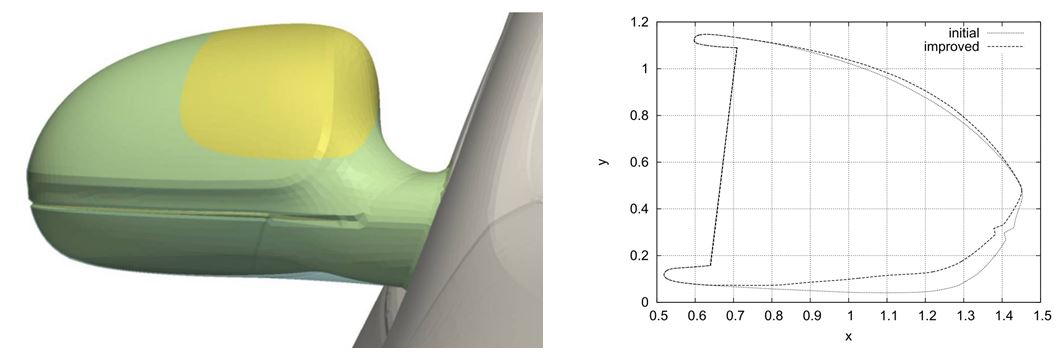
Industrial designs often contain features (e.g. feature lines in automotive design) that should be conserved during the shape optimization, even though the are not included in the global optimum. Assuming the initial design contains such features, the sensitivity information usually would have local maxima at these areas, trying to remove these. If the filter radius is larger then this peak in sensitivity, it will be smoothed and the design feature is preserved.. [Hojjat et al. 2014]
Publications
- Geiser, Armin; Schmölz, David; Baumgärtner, Daniel; Bletzinger, Kai-Uwe: Discretization-independent node-based shape optimization with the Vertex Morphing method using design variable scaling. Structural and Multidisciplinary Optimization 67, 2024, DOI
- Najian Asl, Reza; Bletzinger, Kai-Uwe: The implicit bulk-surface filtering method for node-based shape optimization and a comparison of explicit and implicit filtering techniques. Structural and Multidisciplinary Optimization 66 (5), 2023, DOI
- Hojjat, M.; Stavropoulou, E.; Bletzinger, K.-U.: The Vertex Morphing method for node-based shape optimization. Computer Methods in Applied Mechanics and Engineering 268, 2014, 494-513, DOI
- Bletzinger, K.-U.: A consistent frame for sensitivity filtering and the vertex assigned morphing of optimal shape. Structural and Multidisciplinary Optimization 49 (6), 2014, 873-895, DOI