
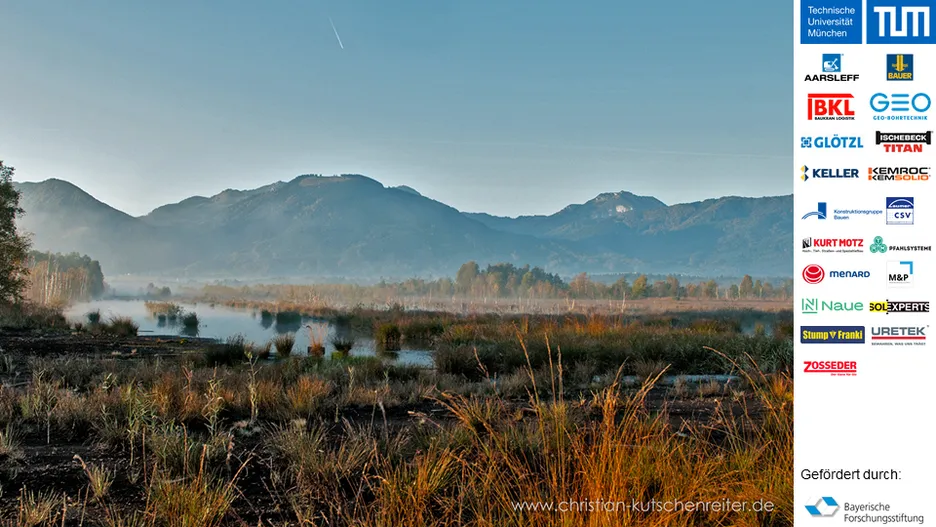
Civil engineers are faced with limitations using conventional methods in muddy basin sediments, which are frequently encountered in the lake regions of Southern Bavaria. Through unique field experiments and novel modeling approaches, essential foundations for a sustainable design of foundations in these particular soils are to be established.
Structurally sensitive fine-grained limnic soils, colloquially known as lacustrine clays, exhibit the peculiarity of significantly losing their already relatively low shear strength when disturbed from their natural state. Compared to other soft soils, lacustrine clays are particularly challenging: this applies both to exploration and soil mechanical characterization, as well as to the load-carrying behavior of foundations, which is significantly influenced by the intensity of construction-related interference.
Common field and laboratory methods, as well as modeling approaches that form the basis of foundation design, reach their limits. The functionality of foundation systems successfully applied in soft soils with high structural sensitivity cannot be assumed. This complicates the implementation of construction projects and can even call their feasibility into question.
In the past, in Southern Bavaria, the construction use of areas with such high ground construction risk could often be avoided. However, the demand for infrastructure for mobility, as well as the development of sites for commercial and residential use, makes sustainable utilization of all available areas, considering ecological, economic, and social aspects, unavoidable in the future.
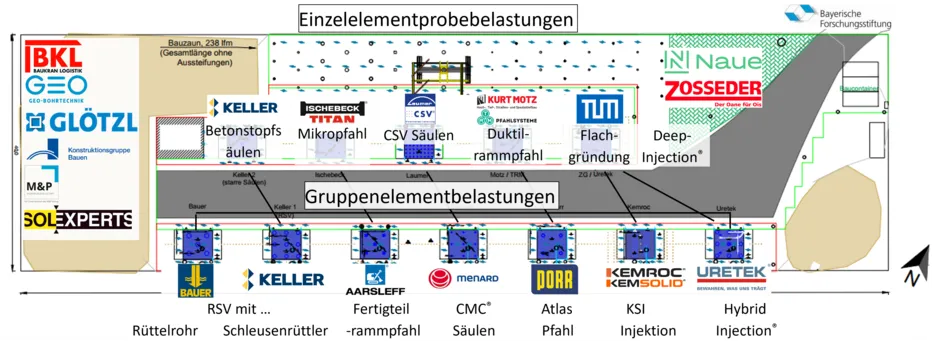
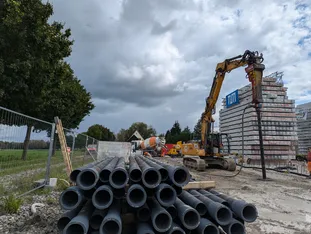
On a test site of around 6,000 m² in Kolbermoor near Rosenheim, large-scale load tests will be carried out on twelve foundation systems and an additional shallow foundation which is unique in terms of design and scope worldwide. The results of the load tests and the accompanying advanced field and laboratory tests are used to validate novel modeling approaches. Subsequently, the efficiency and sustainability of the considered foundation methods concerning region-specific soils will be evaluated. The ecological footprint will be considered from the production to the possible dismantling of the foundation.
Public Relations and Reporting on the Research Project:
Current events::
Registration for the VHS Course "Research Project: Building on Clay Soil" including Construction Site Tour - VHS Kolbermoor
Friday, May 16, 2025 - 16:00 - 18:00, Kolbermoor
Past:
- Regional Television Oberbayern rfo (Video report, 2024)
- Bavarian Broadcasting BR (Video report, 2024)
- OVB (Online article, 2024)
- OVB (Newspaper article, 2024)
- OVB (Online article, 2021)
- Radio Charivari (Newsfeed, 2024)
Zone loading test - group loading:
Current Status – April 2025:
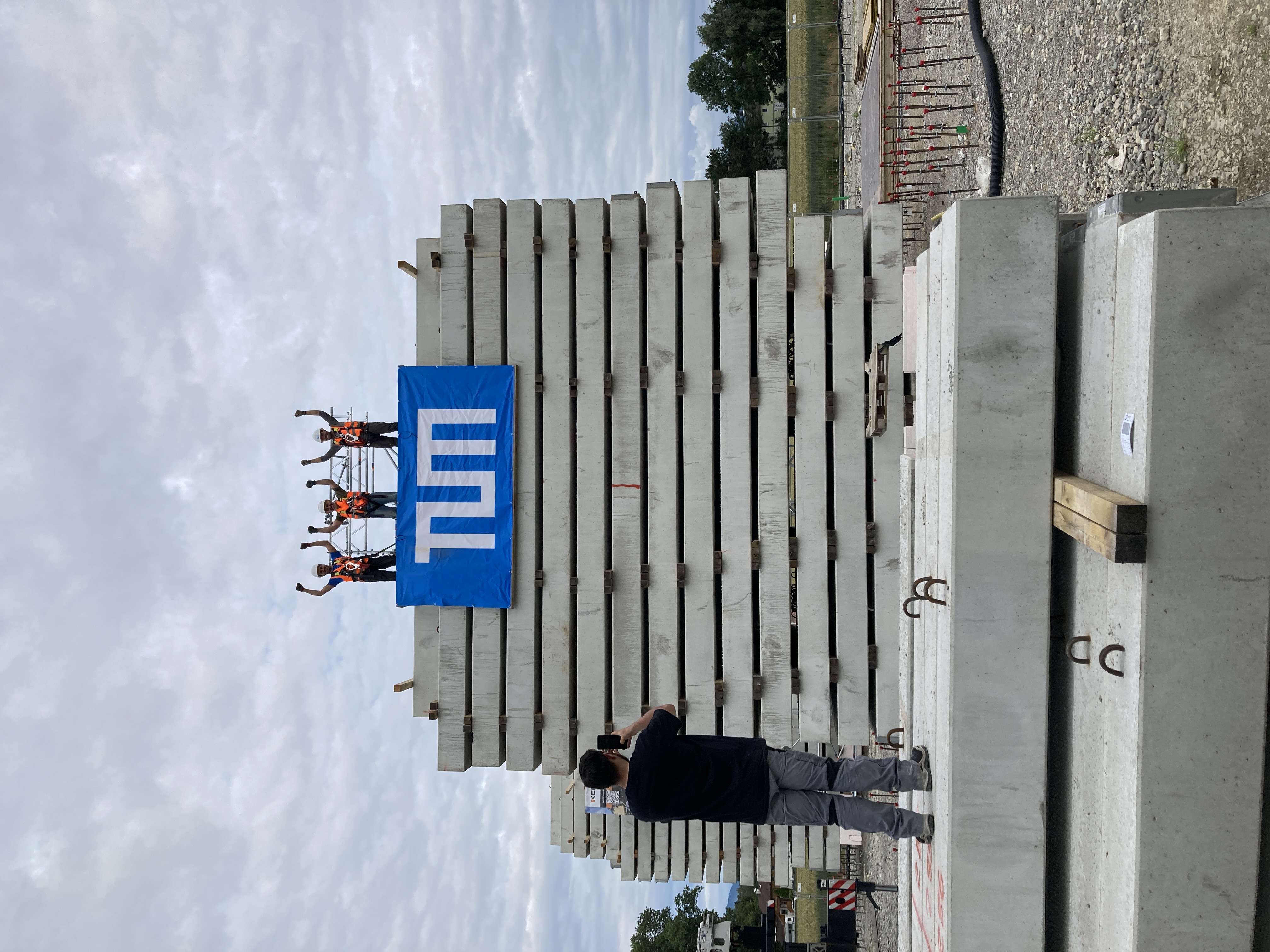
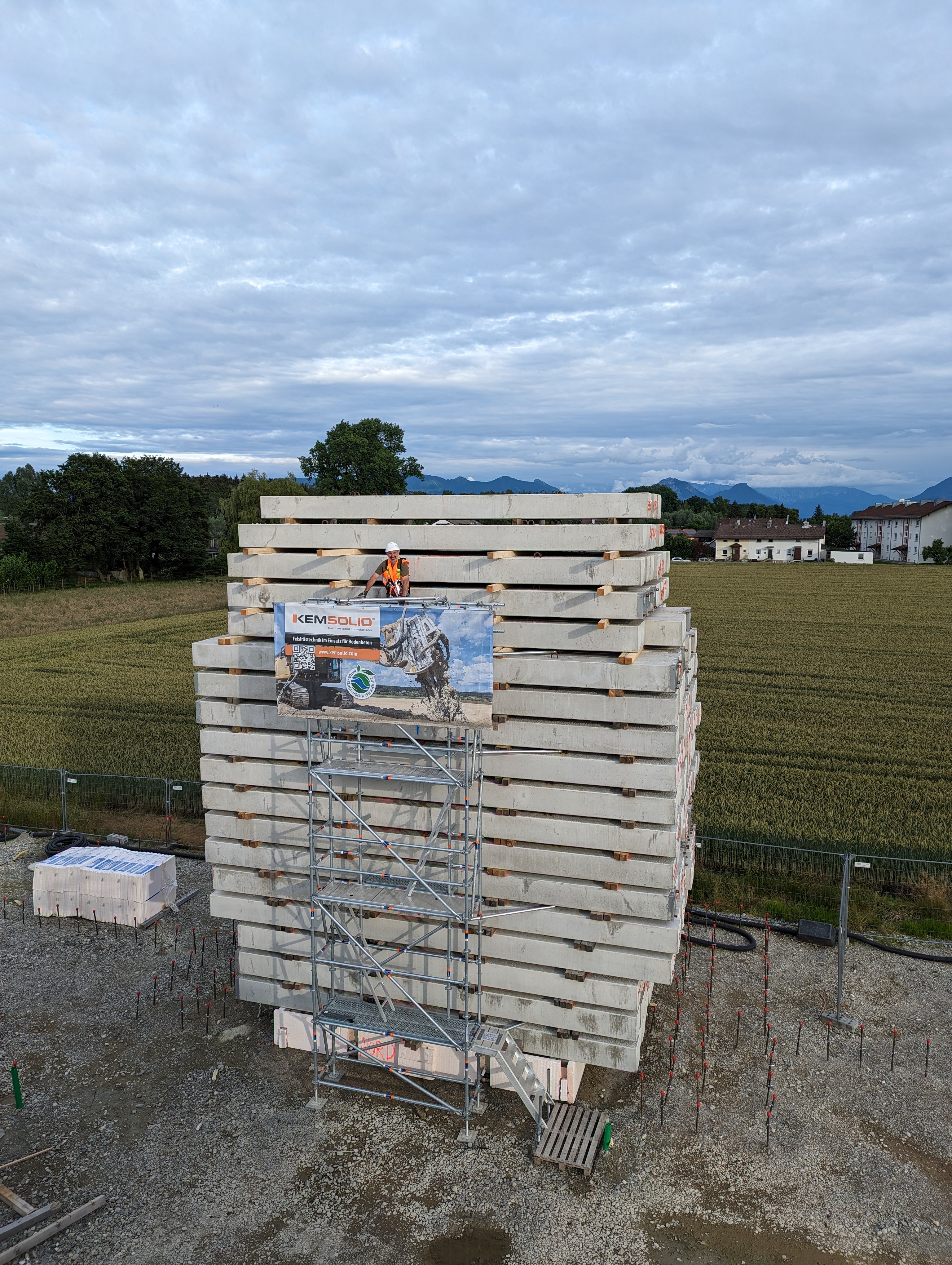
Building on the geosynthetic trials, individual element and group load tests are currently being conducted simultaneously with at least two test fields. The dead loads and 5 m x 5 m mobile foundations are being gradually stacked by BKL through loading, unloading, and reloading phases of the foundations, with a maximum of about 640 tons each. For all 13 test fields (including one test field for uplift injections to investigate remediation options for serviceability issues), a total of approximately 4,000 linear meters of vertical drains were previously installed by Menard.
The first two test fields – shallow foundation (TUM Geotechnical Center) and milling-mixing method (Kemroc) – were loaded stepwise over a period of approximately 6 months each. The subsequent unloading cycle is equivalent to the loading of the next test fields. The loading cycles for the subsequent test fields – Ductile Driven Pile system (Kurt Motz with Tiroler Rohre) and Atlas Pile system (Porr Group, specializing in deep foundation engineering) – are currently in the relief phase and are each subject to around 210 tons of dead load (average base pressure approx. 83 kPa)
- Dry mortar stabilization columns CSV (Laumer) – Early February 2025
- Controlled Modulus Columns CMC (Menard) – Mid February 2025
Following the aforementioned foundation construction, the two test fields - dry mortar stabilization column system type CSV (Laumer) and wet mortar column system CMC (Menard) - are currently in the second load stage with a dead load of around 420 tons each (average base pressure approx. 174 kPa)
Measurement Technology for Each Test Field – With the support of cooperation partners Glötzl and Solexperts:
- Extensometers at multiple depth levels
- Sliding deformeter
- Inclinometer for measuring horizontal deformations and seismic cross-hole tests
- Earth pressure and pore water pressure gauges at multiple depth levels
- Hydraulic settlement sensors below and at foundation edges
- Geodetic measurement bolts
Site Investigation – Conducted and supported by cooperation partners Geo-Bohrtechnik and Mull & Partner:
For over a year, various site investigation campaigns have been continuously carried out, with accompanying evaluations. The field tests (in-situ) include, among others:
- Plate load tests (static & dynamic)
- Cone penetration tests with pore water pressure measurement (CPTu)
- Seismic cone penetration tests (SCPT)
- Vane shear tests
- Cross-hole tests
- Innovative Self-Boring Pressuremeter tests (new in Germany)
- Menard Pressiometer
- Marchetti Medusa / SDMT
- Tomographic measurements
These field tests, along with index tests, are complemented by extensive and innovative laboratory tests (e.g., Bender Element, P-Rat, etc.).
As part of the research project, final work is also currently being carried out on numerical simulations of the settlement forecast, the classification of the lacustrine clay using advanced laboratory tests and the sustainability assessment of the foundation systems.
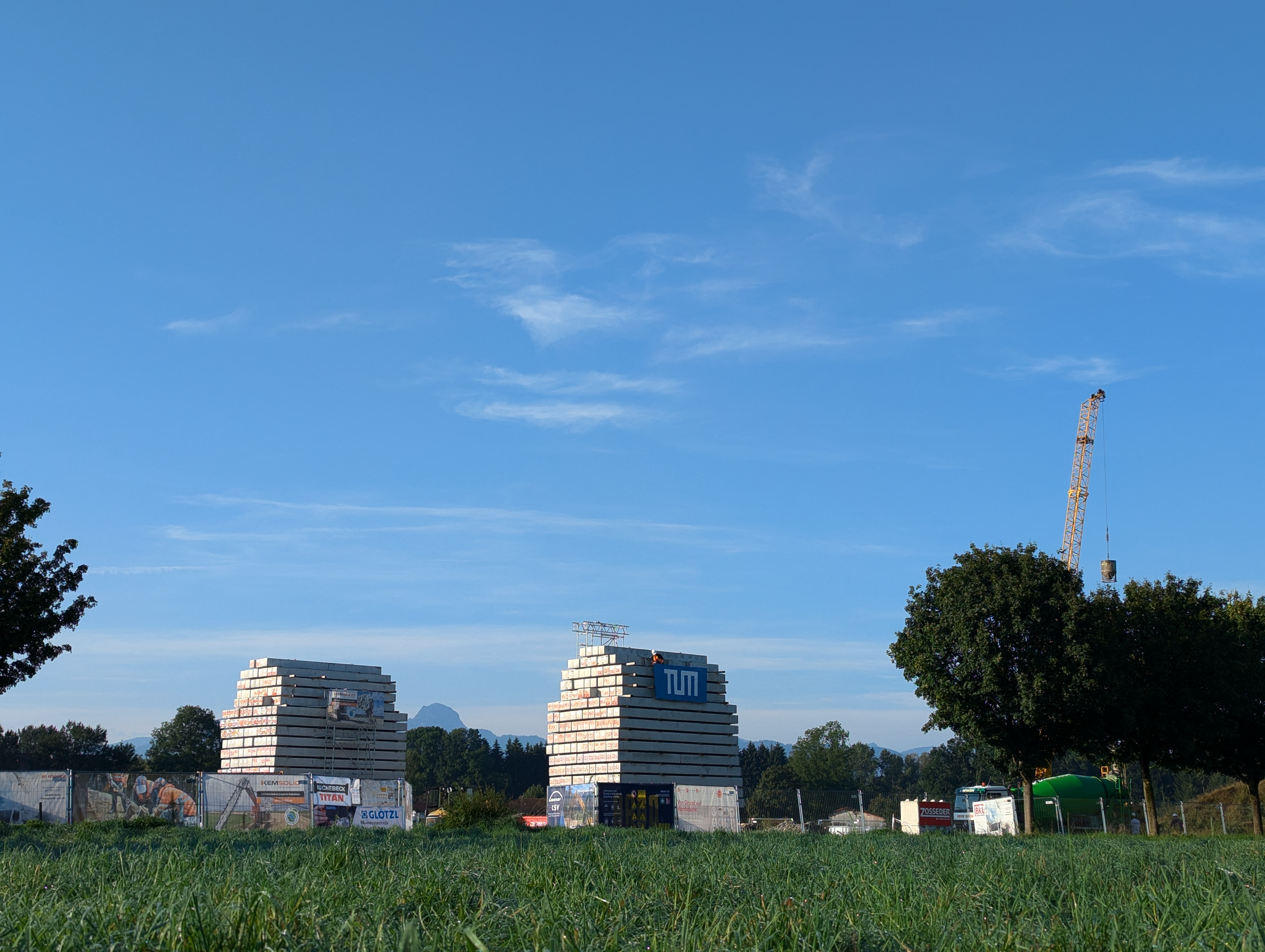
In the background, the Bavarian Pre-Alps with the Wendelstein.
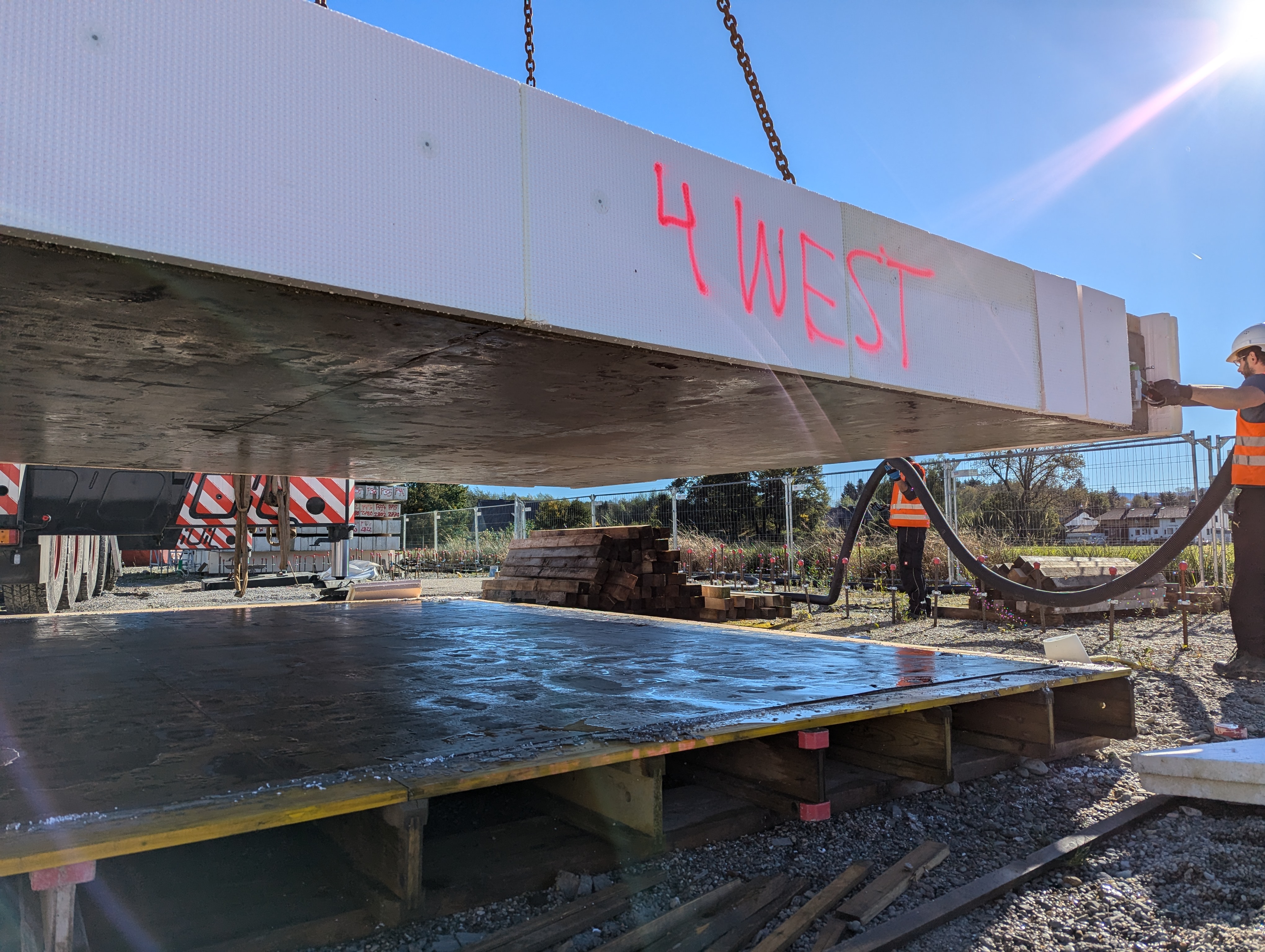
Test field of single loading elements:
Current Status – April 2025:
- Dry mortar stabilization columns CSV (Company: Laumer) – Pile-load-testing in April 2025
- Controlled Modulus Columns CMC® (Company: Menard) – Pile-load-testing in April 2025
Preparations and Implementation:
Based on two preliminary tensile tests conducted on the test field at our own initiative using ductile driven piles from Kurt Motz with Tiroler Rohre, the load-bearing capacities of the foundation variants executed in the research project were estimated for their individual test loads. These will undergo single element test loads at conventional time intervals after installation, in parallel with group load tests.
For each method, a total of three test loads will be performed, some with varying boundary conditions of the production parameters. These will be loaded up to the ultimate limit state (ULS).
- Atlas pile (Company: Porr Group, specializing in deep foundation engineering) – Pile-load-testing completed in October/November 2024
- Ductile driven pile (Company: Kurt Motz with Tiroler Rohre) – Pile-load-testing completed in October/November 2024
Geosynthetic tests:
Test field and preparation – with the support of partners Zosseder and Naue
Prior to the loading tests, geosynthetic investigations were conducted in cooperation with Naue using tracked trucks. These investigations are aimed, among other things, at the specific consideration of the design of reinforced load-bearing layers.
(Using the Firefox browser is recommended for playing the video.)
Publications and Contributions:
- VSVI Seminar 518, Nürnberg - 19.04.2023: Cudmani, R.; Berz, P. - Großforschungsprojekt SEBRO - Effizientes und nachhaltiges Bauen auf strukturempfindlichem gering tragfähigem Untergrund
- Geo-DACH, Burghausen - 04.05.2023: Berz, P. - Effizientes und nachhaltiges Bauen auf gering tragfähigem Untergrund
- 14. Österreichische Geotechniktagung, Wien - 01.-02.02.2024: Rebstock, D.; Cudmani, R.; Vogt, S. - (Misch-)Gründungen im Seeton - Erfahrung in Rosenheim und aktuelle Forschung
- Geoshangai 2024, Shanghai - 26.-29.05.2024: Vogt, S. - Building on Soft Sensitive Lacustrine Clay Building
- 38. Baugrundtagung Spezialsitzung, Bremen - 25.-28.09.2024: Berz, P. - Effizientes und nachhaltiges Bauen auf strukturempfindlichem gering tragfähigem Untergrund - SEBRO